
Teen Therapy Florida: Compassionate Care For Adolescents at Bella Psychological Services
Teen Therapy in Florida: How Bella Psychological Services Can Help Right Now
Bella Psychological Services offers specialized teen therapy across Florida through both in-person sessions and secure telehealth appointments. We work with adolescents roughly ages 12–18 who are facing anxiety, depression, school stress, family conflict, identity questions, and the constant pressure of social media.
Our practice serves families throughout Florida—including Tampa, Orlando, Miami, Jacksonville, and smaller communities—with evening and after-school appointment options designed to fit busy schedules. We are a private pay practice, and we invite parents to call or complete an online form today to discuss how we can help.
Common concerns that bring families to teen therapy:
Persistent anxiety or worry that interferes with daily life
Depression, withdrawal, or loss of interest in activities
Academic stress from honors programs, AP classes, or college prep
Family conflict and communication breakdowns at home
Difficulty with friendships, peer pressure, or feeling overwhelmed by social dynamics
Self esteem concerns related to body image or social media comparison
Major life transitions like divorce, moving, or starting high school
Substance use, risky behaviors, or self harm concerns

Why Teen Therapy Matters in Florida Today
Since 2020, teen mental health challenges in Florida have intensified significantly. Increased anxiety, social isolation, academic pressure, and constant social media exposure have created a perfect storm affecting adolescents across the state.
Florida teens face unique stressors: the competitive pressure of magnet and IB programs, concerns about school safety, hurricane-related disruptions, and a social media culture that never turns off. These factors compound during a critical stage of brain development when the prefrontal cortex—responsible for decision making and emotional regulation—is still maturing.
Therapy offers something most teens don’t have elsewhere: a confidential space outside school and family where they can talk honestly without fear of judgment. Early intervention helps young adults build coping strategies and emotional resilience that serve them for life.
Why early support matters for Florida adolescents:
The adolescent brain responds exceptionally well to learning new coping skills and emotion regulation techniques
Addressing mental health issues early reduces the risk of problems becoming entrenched into adulthood
Teens develop problem solving skills and healthier communication patterns before entering college or the workforce
Building resilience during adolescence creates a foundation for lifelong skills in managing stress and relationships
Early therapy can prevent escalation to more intensive mental health treatment later
Is It Time to Find a Teen Therapist in Florida? Key Signs to Watch
Adolescence naturally includes mood swings, occasional conflict, and identity exploration. But certain patterns signal that professional support could make a real difference for your teen and your family.
Signs that therapy may help:
Persistent irritability or low mood lasting several weeks
Sudden drop in grades or academic performance
School refusal or frequent complaints about going to school
Difficulty falling asleep, sleeping too much, or significant appetite changes
Social withdrawal from friends, sports, or activities they once enjoyed
Angry outbursts, emotional dysregulation, or frequent conflicts at home
Physical complaints like stomachaches or headaches without medical cause
Increased anxiety around specific situations (tests, social events, performances)
Red-flag behaviors requiring prompt attention:
Self harm or talk about hurting themselves
Comments about not wanting to live or feeling like a burden
Increased risk-taking or risky behaviors
Vaping or substance abuse
Concerning online behaviors or secretive technology use
Dramatic personality changes or withdrawal from family
Don’t wait for a crisis. In Florida, securing an appointment with experienced teen therapists can take time, so reaching out early is practical and wise. Seeking help is a sign of care, not failure.
How Teen Therapy at Bella Psychological Services Works
At Bella Psychological Services, we tailor the therapeutic process to each teen while keeping parents appropriately involved. Our goal is creating a safe space where teens feel heard and supported while families gain tools to improve relationships at home.
The process from first contact to ongoing care:
Initial inquiry: You reach out by phone or online form. We schedule a brief consultation to understand your concerns, gather basic background, and discuss your teen’s needs.
Logistics discussion: We review fees, scheduling options, and whether in-person or telehealth fits best for your family.
First session: Your teen meets their therapist for an initial assessment. We focus on building rapport and understanding what matters most to them.
Assessment phase (sessions 2–3): We evaluate mood, anxiety levels, school and peer functioning, family dynamics, and any safety concerns.
Ongoing therapy: Sessions typically occur weekly at first, then may adjust to biweekly as your teen stabilizes and builds confidence.
Treatment length: Some teens benefit from short-term work around a specific issue (like a semester of academic stress), while others need longer-term support for deeper mental health challenges.

What Happens in Teen Counseling Sessions
Sessions are collaborative conversations, not lectures. Your teen is invited to share what matters to them in their own words, at their own pace.
Common elements of a typical 50-minute session:
Talking through recent experiences, challenges, and wins from the week
Learning concrete coping skills like breathing techniques, grounding exercises, or distress tolerance strategies
Practicing communication strategies for handling conflict at home or with peers
Working through structured exercises or worksheets when helpful
Setting small goals or “experiments” to try between sessions
Processing emotions in a supportive environment where they can be honest
We integrate developmentally appropriate techniques—cognitive behavioral therapy CBT strategies, mindfulness, problem-solving approaches, and values-based work—rather than simply encouraging “venting.” The atmosphere is warm, non-judgmental, and oriented toward helping teens feel capable and understood.
How We Involve Parents While Respecting Teen Privacy
Maintaining both teen confidentiality and parent involvement is central to our approach. This balance builds trust with your teen while ensuring you stay connected to their healing journey.
Our approach to privacy and collaboration:
Session content remains private except when there are safety concerns (self harm, harm to others, abuse) or when your teen agrees to share specific information
We schedule regular parent check-ins—typically monthly or as needed—to review overall progress, patterns at home and school, and ways you can support positive change
For younger teens (around 12–14), parent collaboration may be more frequent; older teens often have more privacy with structured updates
We encourage open communication between parents and therapist through secure messaging or brief phone calls
Your teen’s trust in the therapeutic relationship often depends on knowing their privacy is respected
This partnership approach helps teens build self confidence while keeping families connected and informed.
Supporting Your Teen Between Sessions
What you do between sessions matters. Here are practical ways to support your teen’s personal growth without overstepping.
Tips for parents:
Give your teen some quiet time after therapy rather than immediately asking questions—they may need to process
Try open-ended, non-intrusive questions like “Is there anything I can do differently this week to support you?” instead of “What did you talk about?”
Model healthy coping yourself: prioritize sleep, movement, and boundaries with technology
Support any therapy “home practice” or skills assignments your teen mentions
Communicate concerns directly to the therapist via secure message rather than interrogating your teen
Celebrate small wins and progress, even if it seems incremental
Create space for your teen to practice new skills without pressure
Teen Therapy Approaches We Use at Bella Psychological Services
We use evidence based therapy methods that are teen-friendly and tailored to each adolescent’s personality, culture, and goals. There’s no one-size-fits-all approach to mental well being—what works for one teen may not work for another.
Core therapeutic approaches we draw from:
Cognitive Behavioral Therapy (CBT): Identifying and reframing negative self talk and thought patterns that drive anxiety and depression
Dialectical Behavior Therapy (DBT)-informed skills: Teaching emotional regulation, distress tolerance, and interpersonal effectiveness
Acceptance and Commitment Therapy (ACT): Helping teens take value-aligned actions even when feeling overwhelmed
Mindfulness-based strategies: Building present-moment awareness to reduce spiraling thoughts and increase emotional balance
Motivational Interviewing: Working through ambivalence about change in a non-confrontational way
Treatment is collaborative. Teens help set their own goals—whether that’s “fewer panic attacks at school,” “less arguing at home,” or “better focus for AP classes.” Therapy is more than talk therapy about problems; it emphasizes skills practice, real-life experiments, and building on existing strengths.

Coping With Anxiety, Panic, and Constant Worry
Many Florida teens struggle with performance anxiety, social anxiety, and relentless “what if” thinking about school, sports, friendships, and the future. Feeling overwhelmed has become almost normalized—but it doesn’t have to stay that way.
How we help with anxiety:
Using CBT to identify anxious thought patterns and gently test them with small, manageable exposure exercises
Teaching concrete tools like breathing strategies, grounding skills, and “worry scheduling” to reduce overthinking spirals
Building practical skills for managing anxiety before exams, athletic tryouts, performances, and social events
Helping teens understand the difference between helpful and unhelpful worry
Creating personalized plans to manage stress in daily life
Outcomes families often see:
Better sleep and fewer racing thoughts at night
Reduced panic episodes or physical anxiety symptoms
More confidence in social situations
Improved ability to manage stress without avoidance
Stronger relationships with peers and family
Depression, Low Motivation, and Feeling “Numb”
Depression in teens often looks different than in adults. You might notice your teen staying in their room constantly, pulling away from friends, becoming increasingly irritable, losing interest in sports or clubs, or missing school more frequently.
How therapy addresses depression:
Helping teens name and process emotions they may have been avoiding
Challenging hopeless or negative self talk through evidence-based techniques
Using behavioral activation—small, manageable actions—to rebuild energy and interest
Supporting healthy sleep routines and daily structure
Addressing underlying issues like low self esteem, relationship challenges, or identity exploration
Important reassurance: Talking about depression or suicidal thoughts in therapy does not “put the idea in their head.” Research consistently shows that open conversation about these topics increases safety and connection. If your teen is struggling with thoughts of self harm or not wanting to live, professional support is essential.
Outcomes families often see:
Improved mood and more engagement with daily life
Return of interest in activities and hobbies
Better family connection and communication
Increased self worth and hope for the future
More energy and motivation
School, Sports, and Academic Pressure in Florida Teens
Florida’s academic environment can be intensely competitive. Between end-of-course exams, AP/IB workloads, competitive magnet programs, year-round club sports, and early college admissions pressure, many teens are running on empty.
How we support academic stress:
Developing time management and study strategies that actually work
Addressing perfectionism, fear of failure, and unhealthy achievement pressure
Balancing extracurriculars with rest and recovery
Building executive functioning skills: planning assignments, breaking tasks into steps, using planners and apps effectively
Supporting student-athletes with performance anxiety, burnout, and identity concerns after injury or sport changes
Outcomes families often see:
More balanced schedules with room for rest
Reduced burnout and resentment toward school
Healthier expectations and self-compassion around grades
Improved focus and follow-through on assignments
Better ability to manage stress during high-pressure periods
Friendships, Bullying, and Social Media
Florida teens navigate complex in-person peer dynamics plus constant online contact through TikTok, Instagram, Snapchat, and group chats. This combination creates unique challenges for healthy relationships and self esteem.
How therapy helps with social challenges:
Addressing cyberbullying, exclusion, friendship ruptures, and social drama
Working through body image issues and self esteem challenges linked to social media comparison
Building communication skills, assertiveness, and healthy boundaries
Recognizing unhealthy or unsafe relationships early
Helping families create reasonable technology agreements that feel collaborative rather than punitive
We don’t demonize technology—it’s a fundamental part of how teens connect today. Instead, we help teens develop increasing awareness of how social media affects them and learn to use it more safely and intentionally.
Online & In-Person Teen Therapy Across Florida
Bella Psychological Services provides both secure online therapy across Florida and in-person sessions where our offices are available. Many families find telehealth especially convenient for their busy schedules.
Benefits of online teen therapy:
Accessible from anywhere in Florida—Tampa, Miami, Jacksonville, the Panhandle, or smaller communities
Convenient for families with dual-household situations or complicated schedules
Eliminates transportation barriers and commute time
Often easier for teens with social anxiety to start comfortable opening up
Same licensed therapists provide both online and in-person care
Sessions conducted via HIPAA-compliant video platforms for privacy and security
Research consistently supports online therapy as effective when the therapeutic relationship is strong. For many teens, starting online makes therapy feel more accessible and less intimidating before potentially transitioning to in-person sessions.

Choosing Between Online and In-Person Sessions
Both formats can be highly effective. The right choice depends on your family’s specific situation and your teen’s preferences.
Factors to consider:
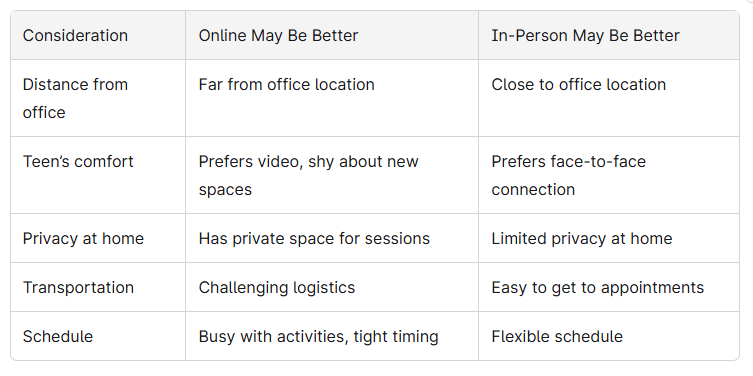
We can begin online and move to in-person (or vice versa) as needs change—flexibility is built into your treatment plan. Many Florida families use a combination approach: mostly online with occasional in-person meetings.
During your initial consultation, we’ll discuss what format feels right for your family and recommend what fits best.
Finding the Right Teen Therapist in Florida
The “fit” between teen and therapist is often more important than any particular therapy style. A strong therapeutic relationship is the foundation of effective evidence based care.
Tips for finding the right match:
Look for Florida-licensed therapists with specific experience in adolescent mental health
Ask about their approach and what a typical session looks like
Pay attention to how your teen feels after the first few meetings—connection matters
Involve your teen in the decision when possible: reviewing therapist bios together, discussing preferences (like gender of therapist or virtual vs. in-person)
Schedule a 15–20 minute consultation call as a low-pressure way to ask questions and gauge rapport
Questions to ask a potential therapist:
What experience do you have with teens dealing with [specific concern]?
How do you typically involve parents while respecting teen privacy?
What therapeutic approaches do you use most often?
How do you handle safety concerns or crises?
What does progress typically look like for teens with similar challenges?
Bella Psychological Services specializes in teen therapy in Florida, and we’re happy to discuss whether we’re the right match for your family—or help guide you toward other resources if needed.
Start Teen Therapy in Florida With Bella Psychological Services
Florida teens don’t have to navigate anxiety, depression, or school and social pressures alone. Evidence based therapy can help your teen build the emotional well being and lifelong skills they need to thrive—and support is available now.
Taking the first step:
Contact Bella Psychological Services by phone or secure online form to schedule a consultation
After-school and early evening appointments are typically available on weekdays
Both online and in-person options are available across Florida
The first step is simply a conversation about your teen’s needs and what might help
Reaching out doesn’t lock you into long-term therapy. The initial consultation is about understanding what your teen is experiencing and exploring whether we’re the right fit to support their healing journey.
If your family is searching for teen therapy in Florida, we’re here to help. Your teen deserves to feel understood, build confidence, and develop the tools for improve relationships and emotional resilience that will serve them throughout their life.